Research · Virginia
Virginia K-12 AI Policy Tracker
Where Virginia’s 131 school divisions stand on AI policy, from public board documents. Updated November 13, 2026.
At a glance
Key numbers
Since July 1, 2026, Virginia law has required every school board to establish, implement and enforce AI policies consistent with guidance from the Virginia Department of Education. This tracker records what each division’s board has actually done, using only public documents. Every status links to its source.
19
Verified divisions
of 131
11
Adopted
6
In draft / on agenda
1
Tabled
1
No policy found
112
Not yet verified
Unknown means we could not verify a status. It does not mean the division has no policy. Many of these divisions may have AI language in their policy manuals that we haven’t reached.
Each record passes three checks before it is published: the data format, the allowed values and dates, and a check that the quoted text appears in the cited source. Records that fail are held back and shown as not yet verified.
Map
Divisions by status
Boundaries from U.S. Census Bureau cartographic files (public domain), simplified for the web. Hatch marks mean the row needs a recheck.
Loading map…
Directory
All 131 divisions
Sortable and filterable. Expand a row for grade-band rules, staff rules, coordinator notes and every source link.
Showing 131 of 131 divisions. Not yet verified means we could not confirm a status — not that the division has no policy.
| Sources | |||||||
|---|---|---|---|---|---|---|---|
| Adopted | Standalone AI policy | Board unanimously approved AI policy at Oct. 28 meeting | 2026-10-28 (Board action) | partial | Yes | Source 1Source 2 | |
| Adopted | Brief AI mention in general policy | Trustees approved policy updates; related guidelines require instruction on AI-generated content | 2026-07-21 (Reported) | — | — | Source | |
| Adopted | Standalone AI policy | Adopted at June 22 work session | 2026-06-22 (Board action) | — | Yes | Source 1Source 2 | |
| Adopted | Standalone AI policy | Adopted (first read March 2, committee second review March 16) | 2026-05-12 (Board action) | — | Yes | Source 1Source 2Source 3 | |
| Adopted | AI section in broader policy | Board approved AI provisions at March 4 meeting | 2026-03-04 (Board action) | — | Yes | Source | |
| Adopted | Standalone AI policy | Amended by School Board (adopted 12/12/23) | 2026-02-10 (Board action) | — | Yes | Source 1Source 2 | |
| Adopted | Standalone AI policy | School Board adopted amended Policy 5430 | 2025-06-24 (Board action) | — | Yes | Source 1Source 2 | |
| Adopted | Brief AI mention in general policy | AUP prohibits directing AI tools to violate the policy (date AI language added not confirmed; last listed amendment June 15, 2023) | — | — | — | Source 1Source 2 | |
| Adopted | AI regulation | Regulation in force (date not confirmed in source text) | — | — | Yes | Source | |
| Adopted | Brief AI mention in general policy | AUP requires authorization for AI tools and instruction on AI-generated content (date not confirmed) | — | — | — | Source | |
| Adopted | AI section in broader policy | Board policy addresses AI; board heard AI use update Nov. 10, 2026 (date of amendment not confirmed) | — | — | — | Source 1Source 2 | |
| In draft / on agenda | Standalone AI policy | Expected to discuss the proposed policy in December 2026 | 2026-12 (Expected) | Yes | — | Source | |
| In draft / on agenda | Standalone AI policy | Early drafts presented to governance committee; formal vote expected Feb. 11, 2027 | 2026-10-27 (Board action) | — | Yes | Source 1Source 2Source 3 | |
| In draft / on agenda | Standalone AI policy | Board work session discussed key updates to its AI policy | 2026-08-06 (Reported) | — | — | Source 1Source 2 | |
| In draft / on agenda | Standalone AI policy | Draft policy to go to policy committee Aug. 5 (outcome not verified) | 2026-08-05 (Expected) | — | — | Source | |
| In draft / on agenda | AI section in broader policy | Division developing academic-integrity policy to address AI | 2026-07-29 (Reported) | — | Yes | Source 1Source 2 | |
| In draft / on agenda | AI section in broader policy | Administrators presented draft AI literacy plan and previewed tech-use policy revisions | 2025-03-18 (Reported) | — | — | Source | |
| Tabled | Standalone AI policy | Board voted to table until next month (December 2026) | 2026-11-09 (Board action) | Yes | Yes | Source | |
| No policy found | — | Division said it does not currently have a formal AI policy; teachers given AI guidelines | 2025-09-08 (Reported) | — | — | Source | |
| Not yet verified | — | Board work session on division AI guidance (AI default 'zone 0'; teacher authorization required) | 2026-08-13 (Reported) | — | — | Source | |
| Not yet verified | — | Board agreed to gather information on AI use and consider forming an AI committee | 2026-07-07 (Reported) | — | — | Source | |
| Not yet verified | — | Board work session on K-12 AI adoption (2026-03-17) | 2026-03-17 (Board action) | — | — | Source | |
| Not yet verified | — | Division-wide AI guidelines; teacher pilot to inform future policy | 2026-02-17 (Reported) | — | — | Source | |
| Not yet verified | — | Division said it follows VDOE guidance; work in progress | 2025-09-08 (Reported) | — | — | Source | |
| Not yet verified | — | — | — | — | — | — | |
| Not yet verified | — | Work session on AI guidance; Gemini adopted as district tool (2026-04-24 report) | — | — | — | Source | |
| Not yet verified | — | — | — | — | — | — | |
| Not yet verified | — | — | — | — | — | — | |
| Not yet verified | — | — | — | — | — | — | |
| Not yet verified | — | — | — | — | — | — | |
| Not yet verified | — | — | — | — | — | — | |
| Not yet verified | — | — | — | — | — | — | |
| Not yet verified | — | — | — | — | — | — | |
| Not yet verified | — | — | — | — | — | — | |
| Not yet verified | — | — | — | — | — | — | |
| Not yet verified | — | — | — | — | — | — | |
| Not yet verified | — | — | — | — | — | — | |
| Not yet verified | — | — | — | — | — | — | |
| Not yet verified | — | — | — | — | — | — | |
| Not yet verified | — | — | — | — | — | — | |
| Not yet verified | — | — | — | — | — | — | |
| Not yet verified | — | — | — | — | — | — | |
| Not yet verified | — | — | — | — | — | — | |
| Not yet verified | — | — | — | — | — | — | |
| Not yet verified | — | — | — | — | — | — | |
| Not yet verified | — | — | — | — | — | — | |
| Not yet verified | — | — | — | — | — | — | |
| Not yet verified | — | — | — | — | — | — | |
| Not yet verified | — | — | — | — | — | — | |
| Not yet verified | — | — | — | — | — | — | |
| Not yet verified | — | — | — | — | — | — | |
| Not yet verified | — | — | — | — | — | — | |
| Not yet verified | — | — | — | — | — | — | |
| Not yet verified | — | — | — | — | — | — | |
| Not yet verified | — | — | — | — | — | — | |
| Not yet verified | — | — | — | — | — | — | |
| Not yet verified | — | — | — | — | — | — | |
| Not yet verified | — | — | — | — | — | — | |
| Not yet verified | — | — | — | — | — | — | |
| Not yet verified | — | — | — | — | — | — | |
| Not yet verified | — | — | — | — | — | — | |
| Not yet verified | — | — | — | — | — | — | |
| Not yet verified | — | — | — | — | — | — | |
| Not yet verified | — | — | — | — | — | — | |
| Not yet verified | — | — | — | — | — | — | |
| Not yet verified | — | — | — | — | — | — | |
| Not yet verified | — | — | — | — | — | — | |
| Not yet verified | — | — | — | — | — | — | |
| Not yet verified | — | — | — | — | — | — | |
| Not yet verified | — | Division AI guidelines published | — | — | — | Source | |
| Not yet verified | — | Division generative AI principles document | — | — | — | Source | |
| Not yet verified | — | — | — | — | — | — | |
| Not yet verified | — | — | — | — | — | — | |
| Not yet verified | — | — | — | — | — | — | |
| Not yet verified | — | — | — | — | — | — | |
| Not yet verified | — | — | — | — | — | — | |
| Not yet verified | — | — | — | — | — | — | |
| Not yet verified | — | — | — | — | — | — | |
| Not yet verified | — | — | — | — | — | — | |
| Not yet verified | — | — | — | — | — | — | |
| Not yet verified | — | — | — | — | — | — | |
| Not yet verified | — | Division AI use guidance (student rules) | — | — | — | Source | |
| Not yet verified | — | — | — | — | — | — | |
| Not yet verified | — | — | — | — | — | — | |
| Not yet verified | — | — | — | — | — | — | |
| Not yet verified | — | — | — | — | — | — | |
| Not yet verified | — | — | — | — | — | — | |
| Not yet verified | — | — | — | — | — | — | |
| Not yet verified | — | — | — | — | — | — | |
| Not yet verified | — | — | — | — | — | — | |
| Not yet verified | — | Division AI Compass / guidance page | — | — | — | Source | |
| Not yet verified | — | — | — | — | — | — | |
| Not yet verified | — | — | — | — | — | — | |
| Not yet verified | — | — | — | — | — | — | |
| Not yet verified | — | — | — | — | — | — | |
| Not yet verified | — | — | — | — | — | — | |
| Not yet verified | — | — | — | — | — | — | |
| Not yet verified | — | — | — | — | — | — | |
| Not yet verified | — | — | — | — | — | — | |
| Not yet verified | — | — | — | — | — | — | |
| Not yet verified | — | — | — | — | — | — | |
| Not yet verified | — | — | — | — | — | — | |
| Not yet verified | — | — | — | — | — | — | |
| Not yet verified | — | — | — | — | — | — | |
| Not yet verified | — | — | — | — | — | — | |
| Not yet verified | — | — | — | — | — | — | |
| Not yet verified | — | — | — | — | — | — | |
| Not yet verified | — | — | — | — | — | — | |
| Not yet verified | — | — | — | — | — | — | |
| Not yet verified | — | — | — | — | — | — | |
| Not yet verified | — | — | — | — | — | — | |
| Not yet verified | — | Division AI acceptable-use guidelines | — | — | — | Source | |
| Not yet verified | — | — | — | — | — | — | |
| Not yet verified | — | — | — | — | — | — | |
| Not yet verified | — | — | — | — | — | — | |
| Not yet verified | — | — | — | — | — | — | |
| Not yet verified | — | Board update on scaffolded generative AI rollout (2026-06-08 report) | — | — | — | Source | |
| Not yet verified | — | — | — | — | — | — | |
| Not yet verified | — | — | — | — | — | — | |
| Not yet verified | — | — | — | — | — | — | |
| Not yet verified | — | — | — | — | — | — | |
| Not yet verified | — | — | — | — | — | — | |
| Not yet verified | — | — | — | — | — | — | |
| Not yet verified | — | — | — | — | — | — | |
| Not yet verified | — | — | — | — | — | — | |
| Not yet verified | — | — | — | — | — | — | |
| Not yet verified | — | — | — | — | — | — | |
| Not yet verified | — | — | — | — | — | — | |
| Not yet verified | — | Division generative AI guidance page | — | — | — | Source | |
| Not yet verified | — | — | — | — | — | — | |
| Not yet verified | — | — | — | — | — | — |
Findings
What boards are deciding
Virginia K-12 AI Policy Tracker, first edition. Data observed November 13, 2026. Data: Schoolhouse (schoolhouse.space), CC BY 4.0.
This report is information only and is not legal advice. Schoolhouse is not affiliated with or endorsed by the Virginia Department of Education, the Virginia Board of Education or the Virginia School Boards Association.
Since July 1, 2026, Virginia law has required every school board to "establish, implement, and enforce policies consistent with the guidance developed by the Department" on artificial intelligence (Va. Code § 22.1-20.2:1(C)). The statute sets no deadline for that guidance or for board policies. So what are boards actually doing in the meantime?
We tried to answer that for all 131 school divisions using only public documents: board policies, BoardDocs records, meeting summaries and local news. Every status in the dataset links to a source, and every field passed a check that the quoted text appears in that source. This first edition has a verified status for 19 divisions. The other 112 are marked unknown. Unknown means we could not confirm a status. It does not mean the division has no policy.
Because the sample is small and depends on what's been published, the numbers below describe the divisions we could verify. They are not statewide rates.
1. Board policy and division guidance are not the same thing
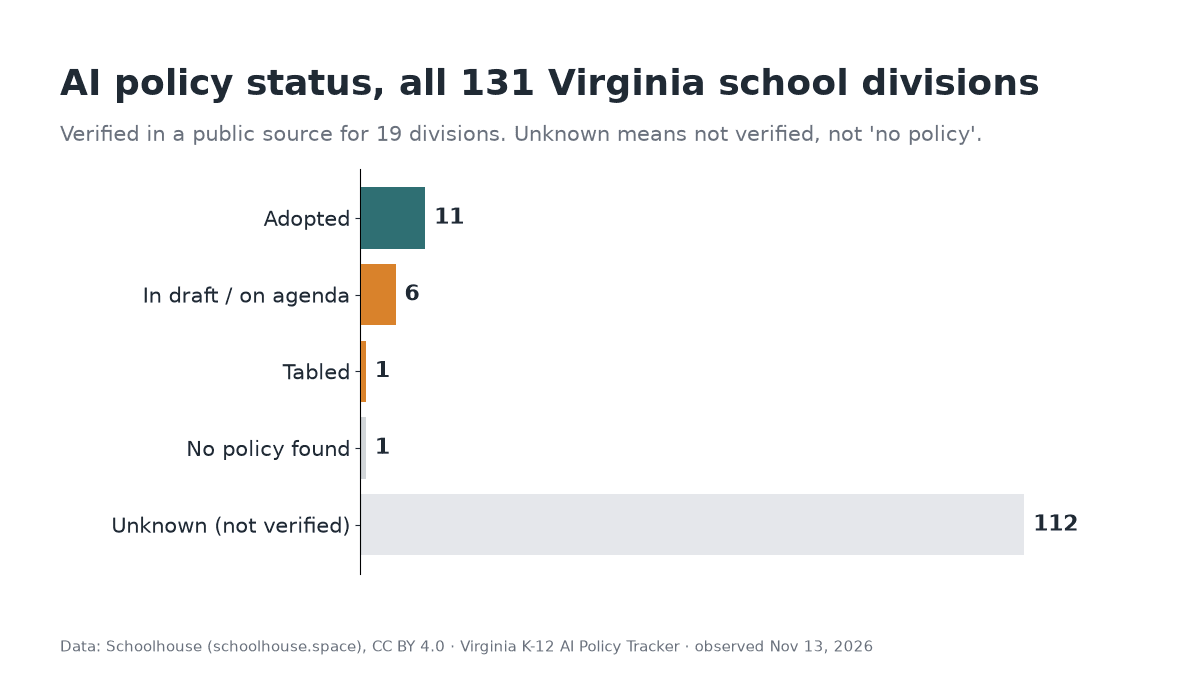
Of the 19 divisions with a verified status:
- 11 have an adopted board policy or regulation that names AI.
- 6 have a draft before the board or a committee, or an item expected on an agenda.
- 1 board tabled a proposal (Martinsville City, November 9).
- 1 division said publicly that it had no formal AI policy (Bedford County, in a September 2025 report).
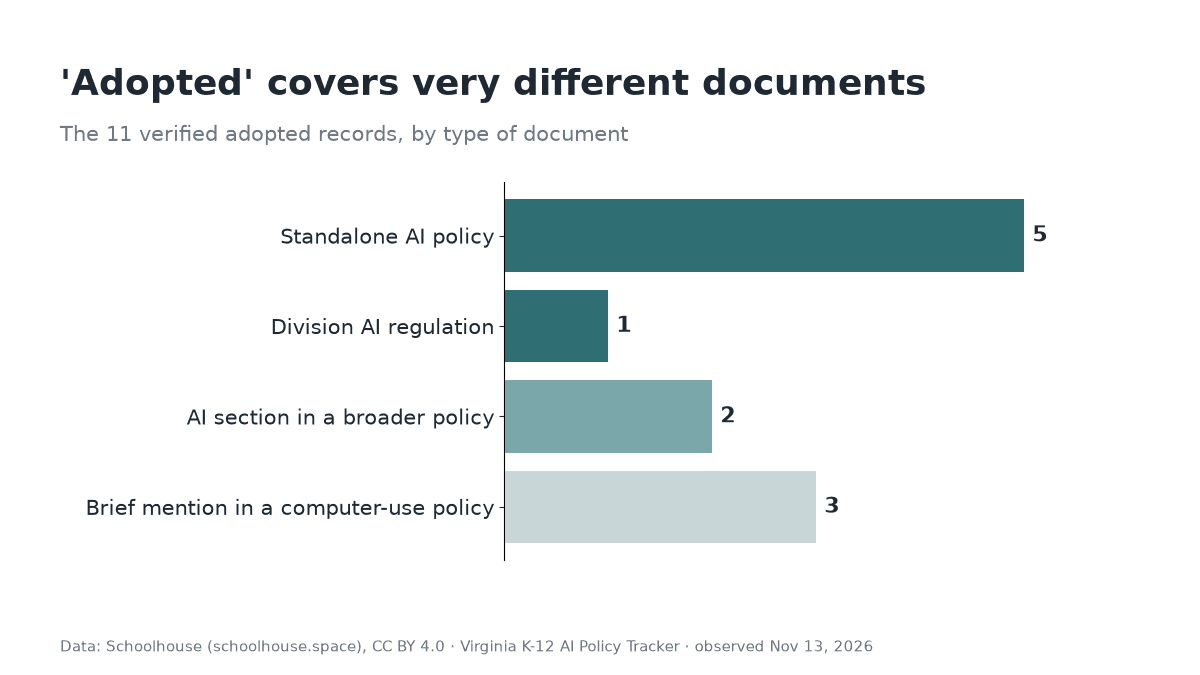
"Adopted" covers a wide range. Of the 11:
- 5 are standalone AI policies: Stafford County, Loudoun County, Richmond City, Falls Church City and Dickenson County.
- 1 is a division regulation (Prince William County, Regulation 295-5).
- 2 put AI rules inside a broader policy: Prince Edward County's acceptable computer use policy and Virginia Beach's digital literacy policy.
- 3 mention AI in a single line of a general acceptable-use policy (Alexandria City, Rockingham County and Mecklenburg County).
Board members comparing notes should check which kind of document a neighboring division actually has. A line saying users may not prompt AI tools to break the acceptable-use policy is a very different thing from a four-page policy with grade-level rules.
Guidance is also common. We found published AI guidance in 18 divisions. In 12 of them we could not verify any board-adopted AI policy: Albemarle, Campbell, Hanover, Harrisonburg, Henrico, Louisa, Lynchburg, Newport News, Norfolk, Salem, Spotsylvania and Winchester. Many divisions appear to be governing AI through staff and student guidance while board policy catches up. Two research reviews from earlier this year describe the same pattern. A George Mason University AI-LIFT review of 50 divisions found 19 with a published policy and 27 with published guidelines. A VCU MERC study of 10 divisions found that six had no AI-explicit language in their governance documents at the time.
2. The fall 2026 wave runs on VSBA language
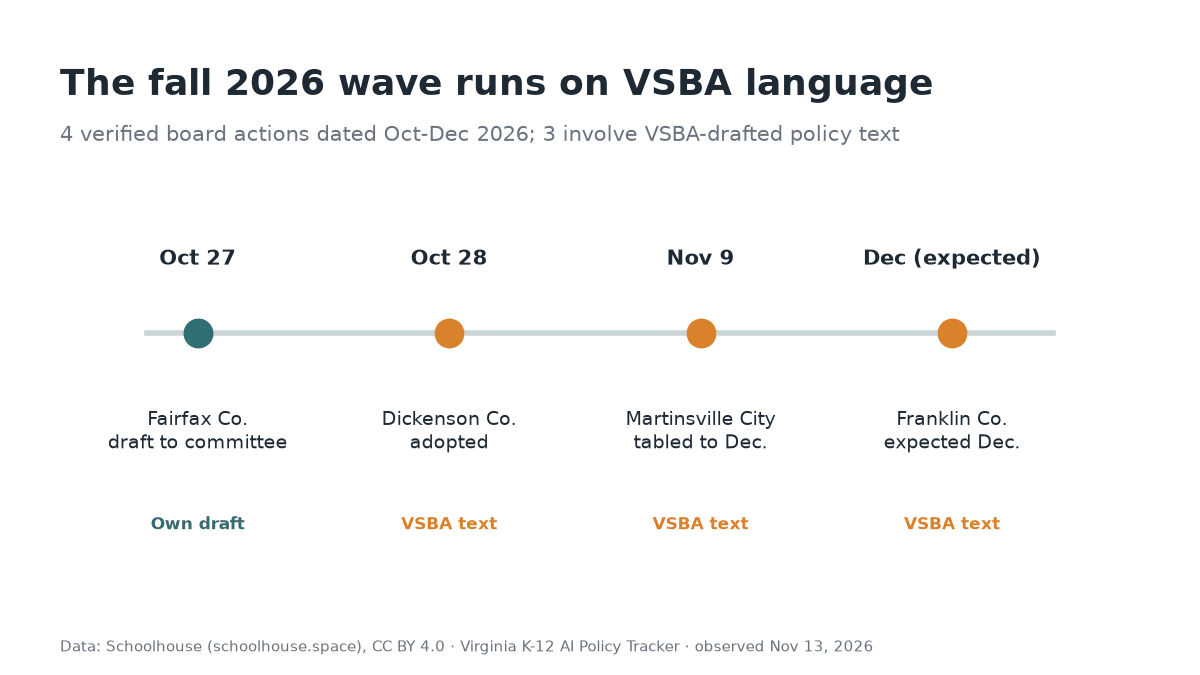
Four verified records have board activity dated October through December 2026. Three of them involve AI policy language drafted by the Virginia School Boards Association (VSBA):
- Dickenson County adopted an AI policy unanimously at its October 28 meeting. The local paper describes it as combining a locally developed draft with the VSBA model policy.
- Martinsville City had two VSBA-drafted options on its November 9 agenda: a broad version and a detailed one. The board tabled both until December.
- Franklin County is expected to discuss the proposed VSBA policy in December, according to a November 9 news report.
The fourth is Fairfax County, which is writing its own policy. Early drafts went to the board's governance committee on October 27, and a formal vote is expected February 11, 2027.
Of the six standalone policies or regulations in the dataset, Dickenson County's is the only one with a confirmed adoption date after the July 1 effective date. Stafford County adopted its policy in December 2023 and amended it in February 2026. Loudoun adopted Policy 5430 in June 2025. Richmond adopted Policy 5-6.6 on May 12, 2026, and Falls Church City adopted Policy II/GF on June 22, 2026. Prince William's regulation has no confirmed date. It looks like many boards adopting now will start from the VSBA text, so the differences between the VSBA options (broad expectations versus detailed permitted uses) are probably worth a close look.
3. Where boards set grade bands, they draw the same lines
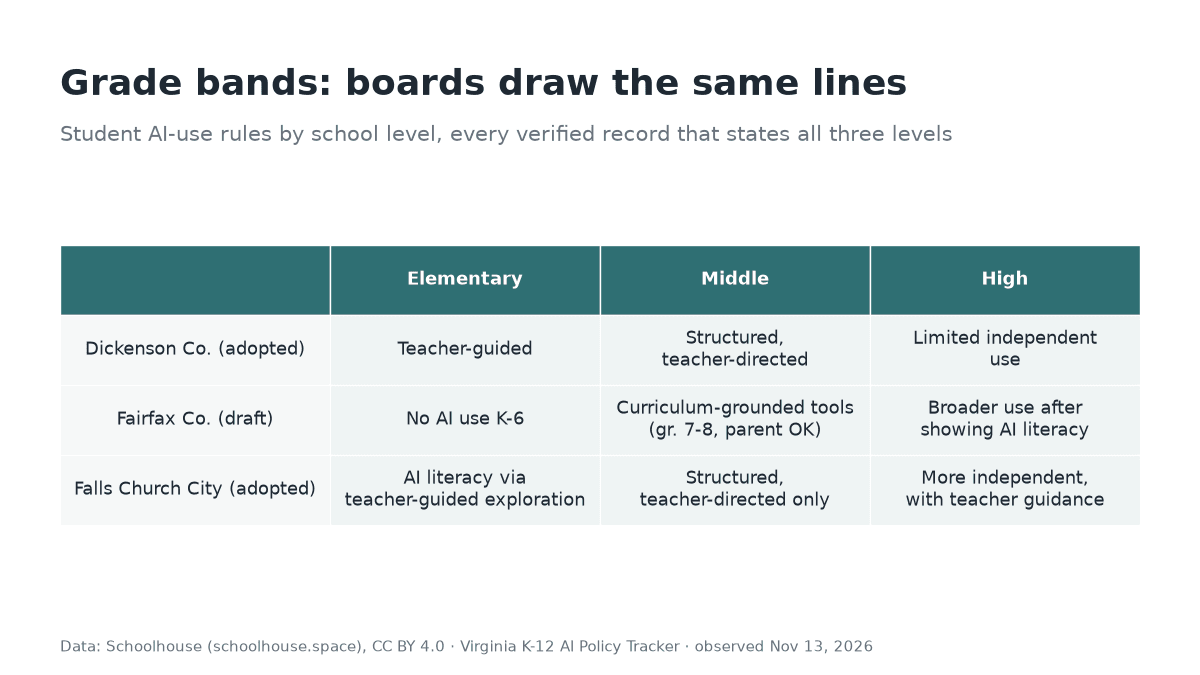
Three records spell out student AI rules by school level, and all three use the same three steps:
| Division | Elementary | Middle | High |
|---|---|---|---|
| Dickenson County (adopted) | Teacher-guided | Structured, teacher-directed | Limited independent use when appropriate |
| Falls Church City (adopted) | AI only to teach age-appropriate AI literacy through teacher-guided exploration | Only structured, teacher-directed activities | More independent, discipline-specific use with teacher guidance |
| Fairfax County (draft) | No AI use in K-6 | Limited "curriculum-grounded tools" in grades 7-8 with parental approval | Broader use after students demonstrate AI literacy |
Fairfax's board also approved a ban on generative AI for elementary students in summer 2026, ahead of the full policy. Richmond's policy doesn't restrict use by grade, but it does set an elementary instruction focus on "awareness and foundations."
This creates a practical problem for elementary teachers. Several of these policies expect students to learn about AI, and Fairfax's draft makes demonstrated AI literacy the condition for broader use in high school. Yet the youngest students may get little or no hands-on use. In those grades, AI literacy has to be taught mostly through discussion, examples and unplugged activities, without students operating AI tools themselves. Teachers in these divisions will need lesson materials built for that. (Schoolhouse publishes AI literacy lessons by grade band, so we have an interest here, and readers should weigh that.)
4. Privacy shows up often. Named coordinators are rare.
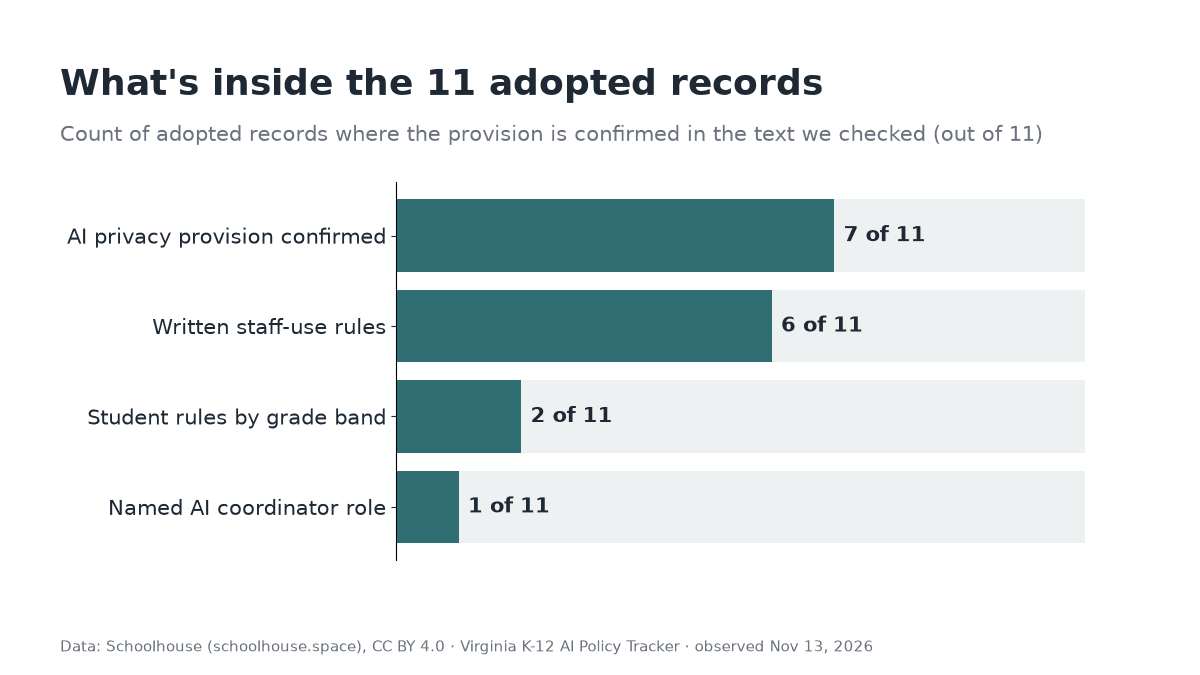
- Data privacy. In 7 of the 11 adopted records, the text we checked includes an AI-related privacy provision. Examples include requiring review before staff enter student information into AI tools (Dickenson), limiting personally identifiable information to approved systems (Prince William), and protecting student and staff data (Richmond). For the other four we could not confirm one either way.
- Staff use. Seven records, counting Martinsville's proposal, contain written rules for teacher or staff use, such as using only division-approved tools, reviewing AI output before using it, and not relying on AI alone for grading or discipline. The VCU MERC study had found staff use to be the weakest area of local AI governance, so this may be starting to change, though seven records are too few to say so.
- AI coordinator. Only one record names a coordinator role: Dickenson County. Richmond's policy assigns oversight to an AI Task Force created by board resolution in 2025.
5. What is still unclear
- State guidance. Section 22.1-20.2:1(B) directs VDOE to post guidance on safe, ethical and equitable AI use. VDOE collected statewide survey data on AI use from divisions, due October 16, 2026. We could not confirm whether the guidance itself has been posted, because VDOE's website did not respond to our tools on November 13. Boards adopting now may need to revisit their policies once it appears.
- The 112 unknowns. Many of these divisions probably have something in their policy manuals that we didn't reach in this pass. We would rather leave a row unknown than guess.
- Secondary sources make mistakes. During research we found a third-party site that attached Richmond's policy number to Henrico, and search results that mixed up Virginia divisions with same-name districts in Nebraska and Maryland. Board documents are the best source.
How to use this
- Board members and division staff: check your division's row. If it's wrong or unknown and you have a public board document, send the link through the Schoolhouse contact form. Corrections go through the same check as everything else.
- Teachers: if your division sets grade bands, ask how AI literacy is supposed to be taught in the grades where students can't use the tools.
- Researchers and reporters: the data is free to reuse under CC BY 4.0 with credit to "Data: Schoolhouse (schoolhouse.space)." The methodology note explains every field and limitation.
Updates are planned behind the same validation check, starting with rows marked needs_recheck.
State context
Law, guidance and research
- Va. Code § 22.1-20.2:1 (SB 394 / HB 1186, 2026)
VDOE must compile current AI uses and post guidance for safe, ethical, equitable AI use in instructional settings; each school board must establish, implement and enforce policies consistent with that guidance. Effective July 1, 2026; no calendar deadline in the section. Pilot program subsection expires July 1, 2030.
- VDOE statewide AIS survey
VDOE ran a statewide data collection on current AI use in public schools under SB 394 (2026), due Oct. 16, 2026, covering AI use, privacy and security, educator training, transparency and division-managed platforms.
- Guidelines for AI Integration Throughout Education in the Commonwealth of Virginia (Executive Order 30 era, non-binding)
Earlier statewide guidelines with principles such as 'do no harm'. Whether VDOE treats these as the subsection B guidance is not confirmed.
- VDOE subsection B guidance
Status unknown as of Nov. 13, 2026: the VDOE website returned 403/timeouts from our tools, so we could not confirm whether the guidance required by § 22.1-20.2:1(B) has been posted.
Status not yet verified as of November 13, 2026.
- VSBA Task Force on Artificial Intelligence
Created Aug. 14, 2025 by the VSBA board; supports drafting sample policy considerations. VSBA-drafted optional AI policy language is now before some boards (e.g., Martinsville, Franklin County).
- VCU MERC study (June 2026), 10 divisions
Six of ten divisions studied had no AI-explicit language in governance documents; staff use had the least governance; none had comprehensive AI-specific training requirements.
- George Mason AI-LIFT preliminary review (July 31, 2026), 50 divisions
Of 50 divisions (15 largest plus 35 random), 19 had a published AI policy, 29 had none identified, 2 under development; 27 of 50 had published AI guidelines.
Reuse
Download and reuse
Free to reuse under CC BY 4.0. Credit: Data: Schoolhouse (schoolhouse.space).
Embed
Badge and credit
Copy the badge HTML or the plain-text credit line required by CC BY 4.0.

HTML badge
Plain-text credit
Corrections
See a mistake? Send a link to a public board document through the Schoolhouse contact form. Corrections go through the same validation checks as the rest of the dataset.
Teaching AI literacy where students can’t use AI tools
Several verified policies expect AI literacy even in grades where student tool use is limited or teacher-guided. Schoolhouse publishes free AI Foundations lessons mapped to grade bands — including K–2 unplugged work and printable kits for 3–5 and 6–8.
Information only, not legal advice. Schoolhouse (MLN Learning LLC) is not a law firm. This tracker is not affiliated with or endorsed by the Virginia Department of Education, the Virginia Board of Education or the Virginia School Boards Association. Statuses reflect public documents we could verify as of the date shown.